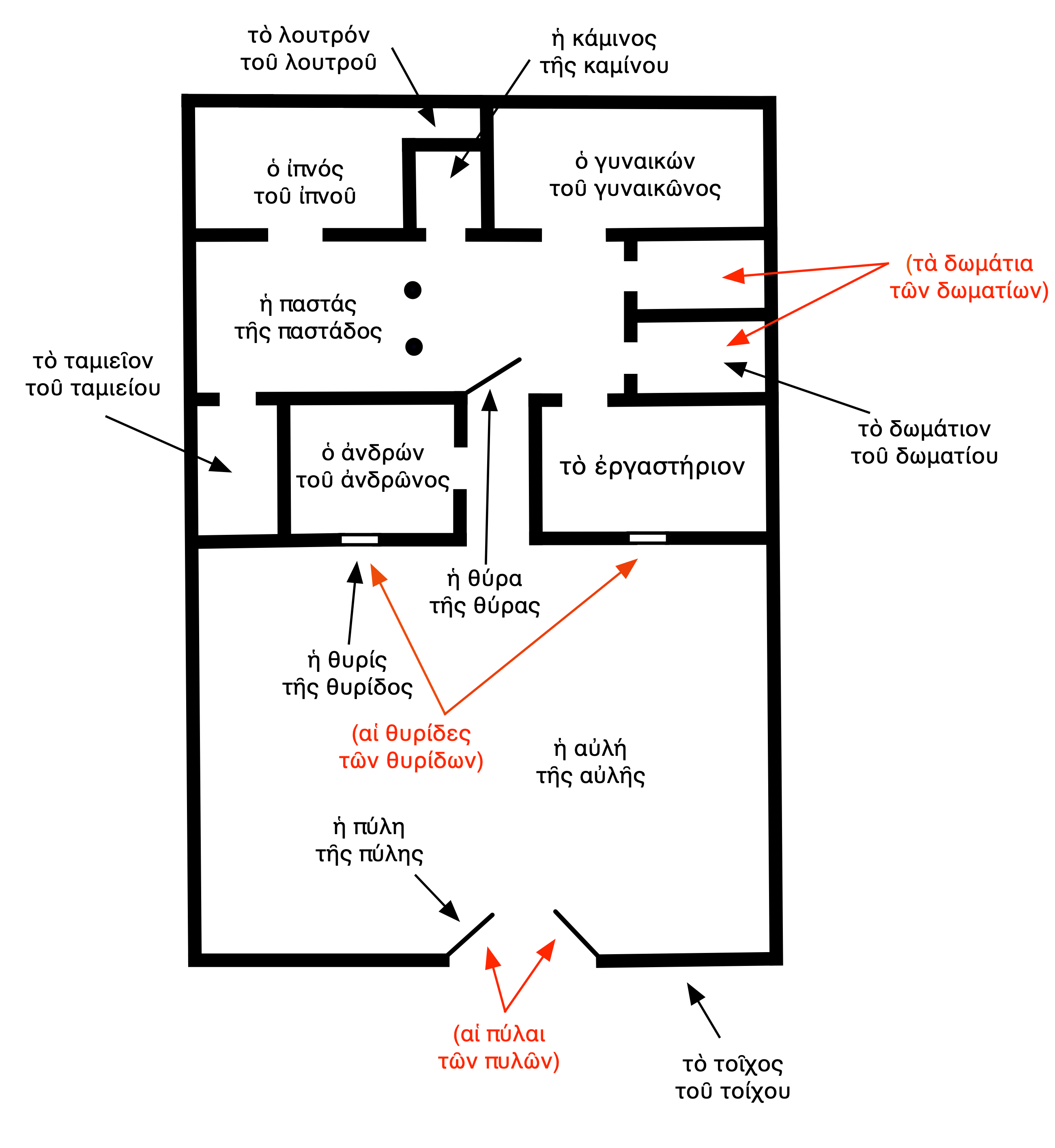
οἰκοῦμεν ἐν τῇ οἰκίᾳ καὶ ἡ οἰκία ἐστιν ἐν τῇ κώμῃ. ἐν τῇ κώμῃ
ἄλλαι οἰκίαι εἰσί καὶ ἐν ταῖς οἰκίαις οἰκοῦσι ἄλλοι ἄνθρωποι.
ἱστάμεθα ἐν τῇ παστάδι τῇ ἐν τῷ μέσῳ τῆς οἰκίας. ἔμπροσθεν ὁρῶμεν
δύο δωμάτια, ἐν οἷς ὁ ἀδελφὸς καὶ ἀδελφή καὶ ἐγὼ καθεύδομεν.
τρεπώμεθα ἐπ' ἀριστερὰ καὶ νῦν
ἔμπροσθεν ὁρῶμεν τὴν κάμινον, ἐν ᾧ ἄρτον ὀπτῶμεν. καὶ τὸν χειμῶνα ἡ κάμινος θερμαίνει τὴν
οἰκίαν. καὶ ἐξ ἀριστερᾶς ἐστὶ ὁ
ἰπνός, ἐν ᾧ σιτία ποιοῦμεν καὶ ἐσθίομεν. ἐκ δεξιᾶς ἐστὶ ὁ
γυναικών, ἐν ᾧ αἱ γυναῖκες ἐργάζονται καὶ καθεύδουσι. νῦν
τρεπώμεθα ὅπισθεν καὶ ὁρῶμεν ἐκ δεξιᾶς τὸν ἀνδρῶνα, ἐν ᾧ οἱ ἄνδρες
συμποσιάζουσι, καὶ ἐκ δεξιᾶς τοῦ ἀνδῶνος τὸ ταμιεῖον, καὶ ἐκ
ἀριστερᾶς τὸ ἐργαστήριον, ὅπου καθεύδεις.
ἐπ' ἀριστερά / ἐξ ἀριστερᾶς· This
passage contains two new preposition: ἐπί
(on, onto, toward) and ἐκ or ἐξ ("from, out from"). Like similar
expressions in English, which incorporate "left" and "right,"
these exhibit some syntactic variations. The forms ἀριστερά
and δεξιά can be (1) adjectives that have now assumed the
nature of nouns through repeated use and the loss of the noun
which they modified, in this case, χείρ ("hand") just as
in English "on the left" and "on the left hand" are typically
interchangeable, (2) adjectives for which we understand the noun χείρ
but do not express it, or (3) the neuter nominative or accusative
plural adjectives, which can assume the role of an adverb. This
parallels the use of "left" and "right" in English, which can be
nouns, adjectives, or adverbs as in, for example, "I turned left."
In the Greek text above, the preposition ἐπί would
normally assign the accusative case, so if ἀριστερά or δεξιά
were nouns or adjectives that modify elided nouns, the phrase
should be ἐπ' ἀριστεράν or ἐπ' δεξιάν. Consequently, in these
cases we see combinations of a preposition and an adverb, which
mean mean "toward the left" and "toward the right." Conversely, in
the other prepositional phrase with ἐκ
or ἐξ, which always assigns the
gentive case, the objects are either nouns or adjectives and
inflected accordingly, so ἐξ ἀριστερᾶς means "from the left" or
"on the left (of something)" and ἐκ δεξιᾶς, "from the right" or
"on the right (of something)."
τὸν χειμῶνα· you will note that this
noun phrase (definite article and noun) are in the accusative
case. A expression of time in the accusative case conveys the idea
of duration, so this phrase means, "during the winter."
※ Green background color indicates core vocabulary.
| Nouns (τὰ ὀνόματα) |
English Definition | Dict. | Gram. | Author |
| οἰκία |
house ἡ οἰκία the house
(nominative case, singular)
αἱ οἰκίαι the houses (nominative case, plural) |
LSJ |
231 | Xen Her |
| κώμη |
village ἡ κώμη the village
(nominative case, singular)
ἐν τῇ κώμῃ in the village (dative case, singular) |
LSJ |
231 | Xen Her |
| ἄνθρωπος |
a human being ὁ ἄνθρωπος human being (male)
ἄνθρωποι human beings (masculine, nominative, plural) |
LSJ |
231 | Xen Her |
| παστάς |
covered
area, porch ἡ παστάς the porch
(nominative case, singular)
τῆς παστάδος of the porch (genitve case) ἐν τῇ παστάδι in the porch (dative case) |
LSJ |
257 | Her |
| δωμάτιον | bedroom
τὸ δωμάτιον
τὰ δωμάτια the bedrooms (accusative) |
LSJ |
231 | Her Xen |
| κάμινος | furnace, oven, kiln ἡ κάμινος the oven
τὴν κάμινον the oven (accusative case, singular) |
LSJ |
231 | Her Xen |
| ἄρτος | bread ὁ ἄρτος the bread
τὸν ἄρτον the bread (accusative case, singular) |
LSJ |
231 | Her Xen |
| χειμών | winter
ὁ χειμών the winter
(nominative case)
τὸν χειμῶνα the winter (accusative) |
LSJ |
259 | Her Xen |
| ἰπνός |
oven, furnace--place where the oven is
located--kitchen ὁ ἰπνός the kitchen
|
LSJ |
231 | Her |
| σιτίον |
food, grain (mostly in plural) τὰ σιτία food, grain, food made
from grain, i.e., bread
|
LSJ |
231 | Her |
| γυναικών | women's quarters, which corresponds to
the ἀνδρών ὁ γυναικών the women's quarter
(nominative)
|
LSJ |
259 | Her Xen |
| ἀνδρών | a room in a house for entertaining
(which was generally restricted to the adult male
members of the family and their guests) ὁ ἀνδρών the men's quarter
(nominative)
τοῦ ἀνδρῶνος of the men's quarters (genitive) |
LSJ |
259 | |
| ταμιεῖον | a storeroom
τὸ ταμιεῖον the storeroom
|
LSJ |
231 | Her Xen |
| ἐργαστήριον | workshop
τὸ ἐργαστήριον the workship
|
LSJ |
231 | Her Xen |
| Adjectives (τὰ ἐπίθετα ὀνόματα) | English Definition | Dict. | Gram. | Author |
| μικρός,
-ά, -όν |
small
μικρὰ οἰκία small house
(feminine, singular, nominative)
|
LSJ | 287, 347 | |
| πολύς,
πολλή, πολύ |
many
πολλοί many (people) (masculine,
plural, nominative)
|
LSJ | 311 | |
| πλουσίος,
-α, -ον |
wealthy, rich
πλουσίοι wealthy (people)
(masculine, plural, nominative)
|
LSJ | 287, 347 | |
| μέσος,
-η,
-ον |
middle, in the middle |
LSJ | 287 | Her. |
| δύο |
two (indeclinable) |
LSJ | 287, 347 | |
| ἀριστερός,
-ά, -όν |
left
ἐπ' ἀριστερά to the left
ἐξ ἀριστερᾶς from the left |
LSJ | 287, 347 | |
| δεξιός,
-ά, όν |
right
ἐπὶ δεξιά to the right
ἐξ δεξιᾶς from the right |
LSJ | 287, 347 |
| Pronouns (αἱ ἀντωνυμίαι) | English Definition | Dict. | Gram. | Author |
| ἡμῶν |
of us, our (genitive, plural) |
LSJ | 325 | |
| Verbs (τὰ ῥήματα) |
English Definition | Dict. | Gram. | Author |
| ἱστάμαι |
I stand ἱστάμεθα we stand
(intransitive)
|
LSJ |
383 | Her Xen |
| ὁράω |
I see ὁρῶμεν we see
(intransitive)
|
LSJ |
385 | Her Xen |
| καθεύδω | I sleep καθεύδομεν we sleep
καθεύδεις you sleep |
LSJ |
383 | Her Xen |
| τρέπω |
I turn τρεπόμεθα we turn ourselves
τρεπώμεθα Let's turn ourselves |
LSJ |
383 | Her Xen |
| θερμαίνω |
I heat, warm θερμαίνει he (she or it) warms
|
LSJ |
383 | Her Xen |
| ποιέω | I make, do ποιοῦμεν we make
|
LSJ |
385 | Her Xen |
| ἐσθίω | I eat ἐσθίομεν we eat
|
LSJ |
383 | Her Xen |
| ἐργάζομαι |
I work ἐργάζονται they work
|
LSJ |
383 | Her Xen |
| καθεύδω | I sleep καθεύδομεν we sleep
καθεύδεις you sleep |
LSJ |
383 | Her Xen |
| Adverbs (τὰ ἐπιρρήματα) | English Definition | Dict. | Gram. | Author |
| ἐμπροσθεν | facing,
toward, in front of |
LSJ |
342 | Her. Xen. |
| ὄπισθεν | behind,
in or at the back of |
LSJ |
342 | Her. Xen. |